How to Protect Your Brand on Etsy: A Step-by-Step Guide
Etsy, a global online marketplace for handmade, vintage, and custom goods, has grown dramatically since its founding in 2005. It’s home to countless independent creators, offering everything from artisanal jewelry and home décor to digital downloads and personalized gifts. For shoppers, Etsy represents authenticity and a personal touch in an era of mass production.
However, for brand owners, Etsy is a double-edged sword: while it can help drive legitimate brand exposure, it also creates new avenues for IP infringement and counterfeit sales. As such, understanding Etsy's ecosystem and enforcement options is critical in today's fast-moving e-commerce world.
TLDR:
- Etsy's open marketplace model lets counterfeiters list infringing products without pre-vetting, making proactive monitoring your first line of defense.
- Use reverse image search and Google Alerts for free spot-checks, but manual methods only catch what you actively search for across millions of listings.
- IP owners must file through Etsy's dedicated Reporting Portal with trademark registration numbers, timestamped screenshots, and side-by-side comparisons to avoid rejection.
- Takedown rejections most often stem from mismatched trademark details or missing evidence: fix the submission before you refile, not after.
- MarqVision scans Etsy and other global marketplaces using AI to surface suspected infringing listings in a consolidated queue, replacing manual discovery work.
What is Etsy?
At its core, Etsy is a platform designed to connect buyers with independent sellers offering unique products. It caters to consumers seeking something different: often handmade, vintage, or personalized. Sellers create their own Etsy pages to list and sell their items, with Etsy providing the infrastructure for transactions and buyer protection.
Is Etsy legit? Yes. Etsy is a legitimate marketplace with millions of users and strong buyer protection policies. They even offer a purchase protection program to guarantee that buyers can get a full refund if an order never arrives, arrives damaged, or is noticeably different from the listing description.
However, Etsy's open marketplace model comes with challenges. Unlike traditional retail channels, Etsy doesn't control its inventory or vet every product before listing. That makes it easier for counterfeiters and infringers to evade detection, making it harder for brand owners to maintain control over their IP. Unauthorized sellers may list products that mimic branding, use registered trademarks without permission, or outright sell counterfeit versions of goods.
Counterfeits don't just harm the bottom line: they can erode customer trust and damage the hard-won relationships built with consumer audiences. That's why a proactive approach to monitoring and enforcing IP rights on Etsy is important.
Tools to Monitor Etsy for Design Theft
Catching infringement early is far less costly than chasing it down after the damage is done. The right monitoring tools let you detect unauthorized use of your designs, product photos, and brand name before infringing listings gain traction, and before counterfeit sales erode customer trust. Here are three practical approaches, ranked by scale and automation.
Reverse Image Search Tools
Google Reverse Image Search and TinEye are free, accessible starting points for finding unauthorized copies of your product photos across the web, including on Etsy. Upload or paste a URL of your original product image, and both tools will surface visually similar images indexed elsewhere. TinEye is particularly useful for tracking where a specific image has appeared over time.
For a faster workflow, use Google Lens directly on any product image:
- Open the image on your device, then tap or click the Google Lens icon (available in Google Photos, Chrome, or the Google app).
- Review the visual matches returned; look for Etsy listings, third-party shops, or social media posts showing your product photo without authorization.
Reverse image search is best used for spot-checks on your hero product images. It will not catch sellers who photograph a counterfeit themselves, so treat it as one layer in a broader monitoring stack.
Keyword and Brand Name Monitoring
Infringers often use your brand name or product titles to drive search traffic to their listings. Set up a Google Alert for your brand name, product names, and any trademarked slogans; Google will email you whenever new indexed content references those terms, including newly listed Etsy pages. Use quotes around exact phrases (e.g., "YourBrandName handmade ring") to reduce noise.
Complement this with a simple Etsy search bookmark routine: run searches for your brand name and key product descriptors directly on Etsy, then bookmark those search result URLs. Revisit them weekly to scan for new listings that co-opt your branding. It takes minutes, requires no tools, and catches direct name misuse that Google Alerts may index with a delay.
Automated Brand Protection Platforms
Manual search only catches what you actively look for, and on a marketplace with millions of active listings, that means most infringement goes undetected. Automated platforms like MarqVision continuously scan Etsy and other global marketplaces using AI to detect both visual and textual matches to your designs at scale. Instead of running individual searches, you receive a consolidated queue of suspected infringing listings, ranked by similarity and risk, letting your team focus on enforcement decisions instead of discovery work.
How to Report Infringements on Etsy
If you find a listing that uses your intellectual property without authorization, Etsy provides tools to report and request removal. Let’s walk through the process.
Reporting a Suspicious Item (as a User):
Even if you’re not the IP owner, you can flag suspicious listings.
- Go to the bottom of the listing page and click “Report this item to Etsy.”
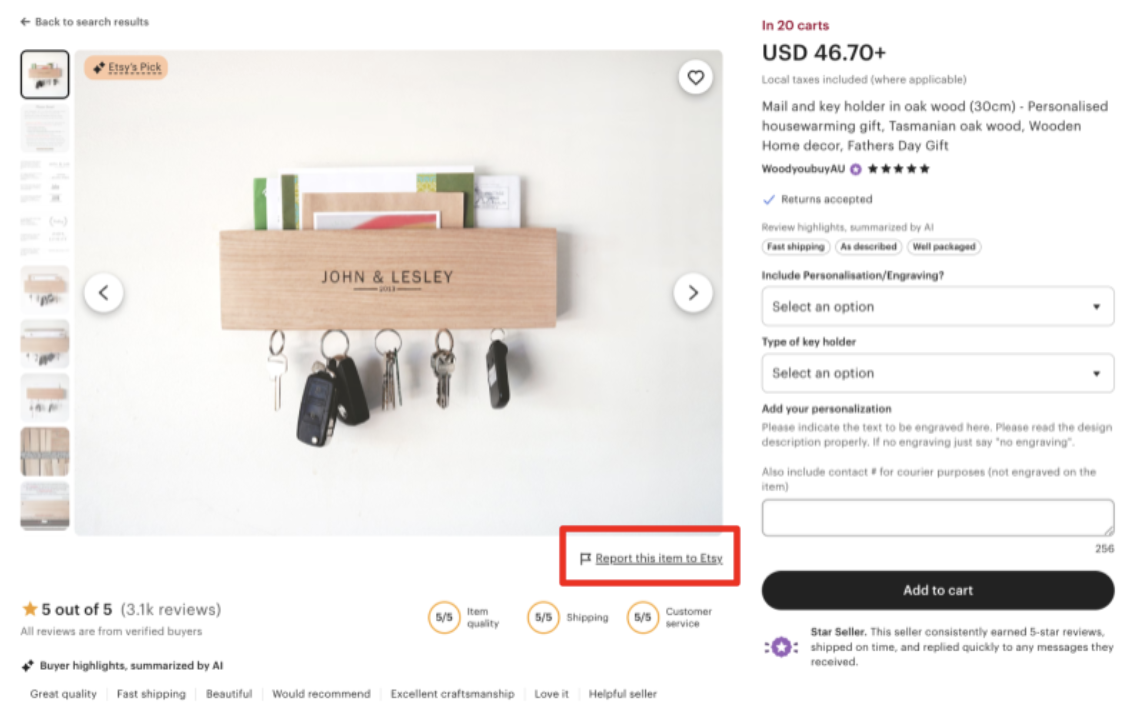
- Choose “I don’t think it meets Etsy’s policies” and select the most appropriate reason.
- Add details about why you’re reporting the item.
- Submit the report.
Etsy’s teams review these reports and will remove the listing if it violates marketplace policies.
Reporting IP Infringement (as the IP Owner):
If you’re the IP owner or authorized representative, you’ll need to use Etsy’s dedicated Reporting Portal.

- Create an Etsy account if you don’t have one already.
- Provide IP ownership details: This includes your legal business name, website, and trademark registration numbers.
- Add evidence: Upload screenshots, URLs of the infringing listings, side-by-side comparisons of your IP and the alleged counterfeit, and any other compelling evidence to support your case.
- Letter of Authorization: If you’re reporting on behalf of an organization, Etsy may request this letter to confirm your authority.
- Search for the infringing listings: use your brand’s keywords and browse all relevant listings. Then select the listings to report.
- Submit your complaint and review for accuracy.

You'll receive an email confirmation once your report is filed. Etsy's team will then review the claim and remove the reported listings if it meets their policies.
What if Etsy Rejects Your Takedown Request?
Etsy’s review process isn’t perfect. Sometimes, even legitimate takedown requests get rejected due to missing information or a lack of evidence.
Here’s how to handle it:
- Document Everything Before You File: Before submitting any takedown, take timestamped screenshots of the infringing listing, capturing the seller name, product images, pricing, and full listing URL. Use a tool like the Wayback Machine or a PDF screenshot tool (such as GoFullPage or Adobe Acrobat) to create a permanent, date-stamped record in case the seller deletes the listing before Etsy reviews your complaint. Record the exact date you first found the infringement. This proactive step prevents rejection by making sure your submission arrives complete and verifiable, and it also dramatically speeds up resubmission if Etsy asks for additional proof.
- Resubmit with More Evidence: If your initial report lacked screenshots or detailed descriptions, strengthen your submission with clearer comparisons and additional proof of ownership.
- Verify Accuracy: Mismatched trademark numbers, outdated company details, or inconsistent product images can cause rejections. Triple-check that everything matches your official records.
- Escalate When Necessary: For repeated denials, especially if the infringing listings are clear and persistent, contact Etsy’s legal team directly. In high-stakes cases, working with an IP attorney to send a formal legal notice may be warranted.
Best Practices for IP Enforcement on Etsy
Proactive monitoring is important for staying ahead of infringers on Etsy. Set up keyword alerts and regularly scan the marketplace for listings that use your brand name, logos, or trademarks. Counterfeiters often create multiple shop names to stay under the radar, so it's key to monitor consistently to catch them before they cause further harm.
Beyond Etsy, it’s also important to educate your customers about how to identify authentic listings and encourage them to report suspicious items. Reinforcing this message in your marketing materials adds an extra layer of brand protection. Lastly, remember that Etsy is just one channel: consistent enforcement across other e-commerce sites like Amazon and Temu, as well as social media platforms, will further strengthen your IP defenses and help preserve your brand’s integrity.
Frequently Asked Questions
Does registering my trademark change what I can do on Etsy's reporting portal?
Yes, and by a wide margin. A registered trademark is the strongest basis for filing through Etsy's IP Reporting Portal. Without a registered mark, your claim rests on common-law rights, which are harder to document and more likely to be rejected. Trademark registration also unlocks additional enforcement channels beyond Etsy, including customs recordation and paid ad takedown workflows on Meta and Google. If your primary exposure is marketplace counterfeiting, filing for trademark registration in the jurisdictions where your products are sold should be your first-order priority before building out any monitoring or takedown program.
What's the difference between reporting an item as a user versus as an IP owner?
Reporting as a user (via "Report this item to Etsy" at the bottom of a listing) flags the listing for a policy review; Etsy checks whether it violates marketplace rules, but you have no formal standing as a rights holder. Reporting as an IP owner through the Reporting Portal is a legal enforcement action: you are asserting ownership of specific rights, submitting evidence, and requesting removal on that basis. The IP owner route carries greater weight and produces faster, more targeted outcomes, but it requires you to substantiate ownership with trademark registration numbers, business documentation, and evidence of infringement. If you're the brand owner, always use the IP owner path.
My Etsy takedown request was rejected. What's the most common reason, and how do I fix it?
The most common causes are missing or mismatched evidence: trademark registration numbers that don't match the jurisdiction of the infringing listing, screenshots that don't clearly show the seller name and product images together, or an incomplete description of how the listing infringes your specific IP. Fix it before you resubmit: don't re-file the same complaint. Take fresh timestamped screenshots of the listing, add a side-by-side comparison of your IP against the infringing product, and triple-check that your trademark details match your official registration records. For persistent rejections on clear-cut cases, escalate to Etsy's legal team directly or engage an IP attorney to send a formal notice.
How often do I need to monitor Etsy, and what's a realistic workflow for a small team?
Infringers move quickly, so consistency matters more than frequency. A practical baseline: run a branded keyword search on Etsy weekly (bookmark your search result URLs and revisit them), set Google Alerts for your brand name and key product descriptors with exact-phrase matching, and run a reverse image search on your hero product photos monthly. This covers the most common attack vectors (name misuse and photo theft) without requiring dedicated tooling. If your team is too small to maintain even that cadence, or if you're seeing high listing volume across multiple marketplaces, an automated platform like MarqVision removes the manual discovery burden entirely by consolidating suspected infringing listings into a single ranked queue.
Is Etsy enforcement enough, or do I need to monitor other platforms too?
Etsy enforcement alone is rarely sufficient. Infringers who are removed from Etsy frequently re-list on Amazon, Temu, or social media within days, and many operate across multiple marketplaces simultaneously. A brand that enforces only on Etsy is playing whack-a-mole while leaving high-volume channels unprotected. The right scope depends on where your products are being counterfeited, and not solely where you sell. If your documented exposure spans several platforms, a consistent cross-channel enforcement program covering major marketplaces, social media, and domain impersonation produces materially better outcomes than single-platform takedowns.
Final Thoughts: Make Brand Protection Easier with MarqVision
Etsy’s vibrant marketplace offers exciting opportunities for brand owners, but also comes with its fair share of challenges. Manually sifting through thousands of listings to find and report infringing products can be a tedious, time-consuming process that drains resources and makes it tough to act quickly against counterfeiters.
That's where MarqVision comes in. Our AI-powered platform automatically scans global marketplaces like Etsy, identifies suspected counterfeit listings, and compiles everything you need to take action, saving you hours of manual searching and paperwork. Instead of reactive, listing-by-listing enforcement, MarqVision brings automation, scale, and speed to your brand protection strategy.
Ready to see how much easier and faster it can be? Contact us for a demo and experience firsthand how MarqVision can help you protect your IP: on Etsy and beyond.
Stay up to date on the latest IP Protection content from MarqVision.




4 Enforcements a Week to 400: Scale Brand Safety with Marq AI

Don’t Just Find Counterfeits. Dismantle the Entire Network.

.png)
Discover the latest trends and challenges in IP protection

Take Control of Your Trademarks with MARQ Folio
Renew and Manage Your Trademarks Easily With MARQ Folio

We’re waiting to hear from you

See the best brand protection solution in action

Don’t let piracy steal your growth

Talk to us about your brand protection problems